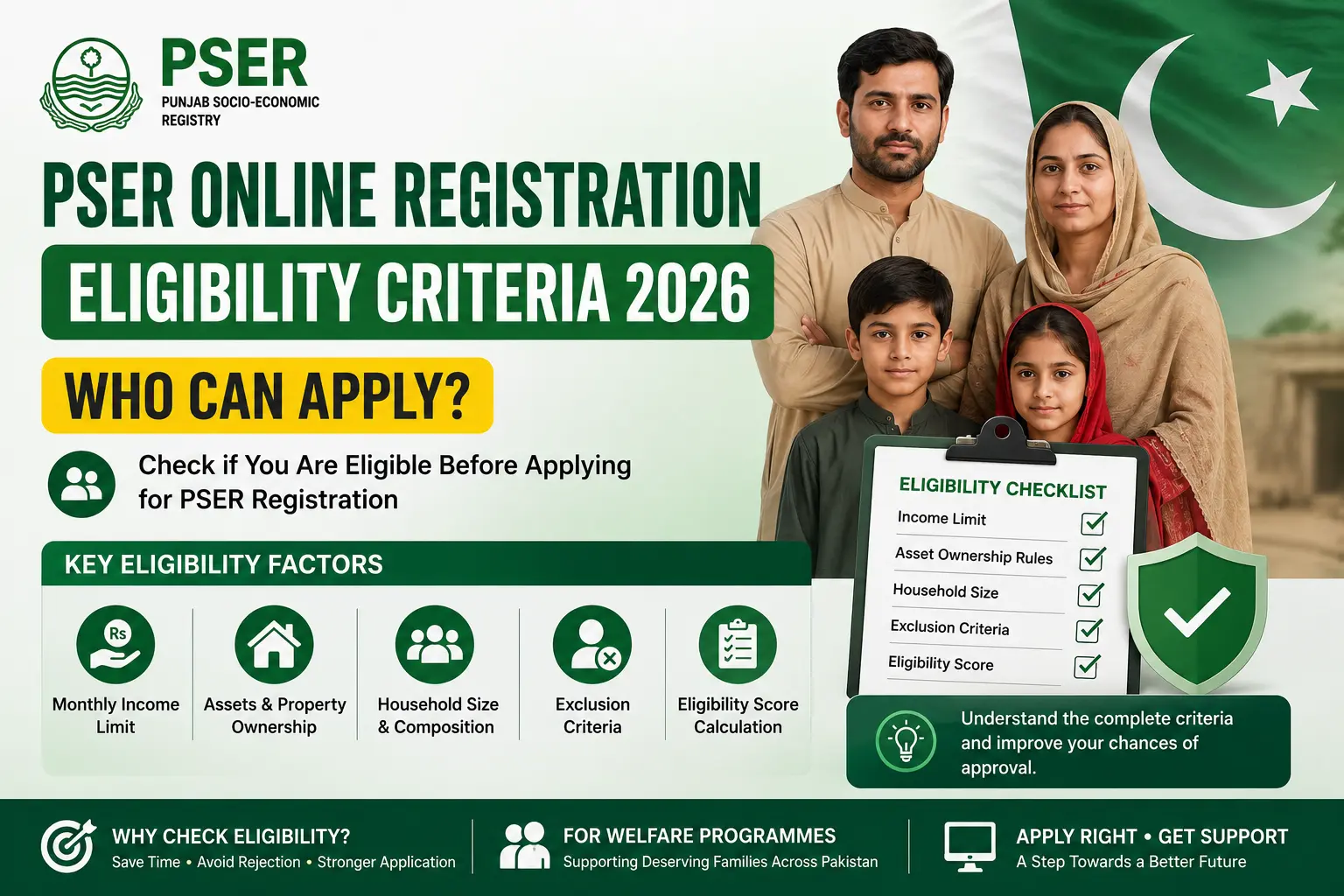
Millions of Pakistani families want to know one thing before applying — whether they are eligible. Understanding the PSER Online Registration Eligibility Criteria before you apply saves time, prevents rejection, and helps you submit a stronger, more accurate application.
This complete guide covers every eligibility requirement in detail — income limits, asset rules, household size factors, who is excluded, and exactly how the government calculates your eligibility score to decide whether your household qualifies for welfare programmes.
What are the PSER Eligibility Criteria? Complete Details 2026
The PSER Online Registration Eligibility Criteria are the set of conditions and household characteristics that the Punjab government uses to assess whether a family qualifies for benefits through the Punjab Socio-Economic Registry. It is important to understand one key distinction from the start:
Registration eligibility and programme benefit eligibility are two different things:
| Registration | Programme Benefits | |
|---|---|---|
| Who can apply | Any Pakistani household | Only households that meet the PMT score threshold |
| Cost | Free | Free |
| Requirements | Valid CNIC + Nadra-verified mobile | Low income, low assets, genuine need |
| When decided | At time of registration | After data review and field verification |
In simple terms — anyone can register in the PSER database. However, only genuinely deserving households with low income, minimal assets, and real financial need will qualify for welfare programme benefits. Your eligibility for benefits is determined by your PMT (Proxy Means Test) score, which is calculated from the household data you submit.
The Punjab government’s approach is deliberately inclusive at the registration stage so that no deserving family is accidentally excluded. The filtering happens after registration through data verification and field visits — not before.
Who is Eligible for PSER Online Registration?
While PSER registration is open to all, the households most likely to qualify for welfare benefits are those that genuinely face financial hardship. The government gives the highest priority to households that meet the following criteria:
Income Criteria
Income is the single most important factor in determining your PSER eligibility score. The lower your household’s monthly income, the higher your PMT score priority.
- Households where the total monthly income is insufficient to cover basic expenses like food, rent, utilities, and medicines are considered high priority
- Households with zero income — unemployed family heads, daily wage workers with no fixed income, or households entirely dependent on informal support — receive maximum income-related priority
- Households where the primary earner is a widow, senior citizen, or a person with disability are treated as a special category with higher priority regardless of the exact income figure
- Informal income — daily wages, small trade, domestic work — is counted as income and must be declared honestly. Declaring false income is a rejection risk during field verification.
- There is no fixed income ceiling published by the Punjab government, but households earning a comfortable living wage are unlikely to meet the PMT score threshold for active programme benefits
Asset Criteria
Assets owned by your household directly affect your PMT score. The fewer significant assets your household owns, the higher your eligibility priority.
Assets the PSER system evaluates include:
| Asset Type | Impact on Eligibility |
|---|---|
| Residential property owned | Owning a large or valuable home reduces eligibility score |
| Agricultural land | Significant land ownership reduces eligibility score |
| Vehicles | Owning a car significantly reduces eligibility score. A basic motorcycle has less impact. |
| Livestock | A large number of livestock (cattle, buffaloes) counts as an asset |
| Business property | Ownership of commercial property or business premises reduces score |
| Appliances and electronics | Basic items (fan, TV) have minimal impact. High-value items (air conditioner, refrigerator) may affect score. |
Households that rent their home, own no vehicle, own no significant land or property, and have minimal possessions score significantly higher on the asset component of the PMT calculation.
Household Size Criteria
Household size is a positive factor in PSER eligibility — larger households with more dependents and fewer earners receive higher priority.
- Households with many children and few or no working adults score higher
- Households where the majority of members are dependents — young children, elderly, or disabled members — score higher
- A household of 6 with one earner scores significantly higher than a household of 3 with two earners at the same income level
- Single-parent households, particularly those headed by widows or divorced women, receive additional priority weighting
CNIC and Residency Requirements
These are the minimum technical requirements that must be met to even submit a PSER application:
- The family head must hold a valid, active Computerised National Identity Card (CNIC) — expired CNICs are not accepted
- The registered mobile number must be Nadra-biometric verified against the family head’s CNIC — check by dialling *789#
- Punjab residency is required for Punjab-specific programmes like the Ramzan Package and Solar Panel Scheme. KPK and Sindh residents can still register and access federal-linked welfare schemes through the same PSER portal.
- All family members aged 18 and above should ideally have their own CNICs — those without CNICs should have B-Forms (for children under 18)
- The household must be a permanent or long-term resident of the address provided — the field verification team will visit this address
Who is NOT Eligible for PSER Registration?
While PSER registration is open to all, certain households are unlikely to qualify for welfare programme benefits even if they complete registration. The following categories are typically screened out during data review and field verification:
- Government employees — Households where the family head or a primary member is a current government servant receiving a regular government salary
- Pensioners receiving adequate pensions — Households already receiving a substantial government pension that covers basic living expenses
- Business owners with significant revenue — Households running established businesses with regular commercial income
- Landowners with substantial agricultural holdings — Families owning significant agricultural land above basic subsistence levels
- Property owners with multiple properties — Households owning more than one residential property or any commercial property
- Households already receiving adequate welfare support — Families already receiving significant benefits from BISP, Ehsaas, or other major government programmes that sufficiently cover their needs
- Vehicle owners (cars/jeeps) — Households owning a car or other significant motorised vehicle are typically scored lower in the asset assessment
- Households with verifiably high incomes — Any household where field verification reveals an income level significantly higher than declared in the application
Important: Being in any of the above categories does not mean you will be rejected from registering. It means your PMT score will be lower, reducing your likelihood of being selected for welfare programme benefits. The PSER database is meant to be comprehensive — the selection filter happens at the programme benefit stage, not the registration stage.
PSER Eligibility Criteria in Urdu (اردو میں تفصیل)
PSER آن لائن رجسٹریشن اہلیت کے معیارات درج ذیل ہیں:
اہل گھرانے — جو درخواست دے سکتے ہیں:
- وہ گھرانے جن کی ماہانہ آمدنی بہت کم ہو اور بنیادی ضروریات پوری کرنا مشکل ہو
- بیوہ، بزرگ شہری، یا معذور افراد کے گھرانے جن میں کوئی کمانے والا نہ ہو
- غریب اور مستحق گھرانے جو خط افلاس سے نیچے زندگی گزار رہے ہوں
- وہ گھرانے جن کے پاس کوئی بڑی جائیداد یا گاڑی نہ ہو
- وہ افراد جو کسی دوسرے بڑے سرکاری پروگرام سے مناسب مدد نہیں لے رہے
- پنجاب میں رہائش پذیر خاندان (پنجاب کے مخصوص پروگراموں کے لیے)
غیر اہل گھرانے — جو فوائد کے لیے منتخب نہیں ہوتے:
- سرکاری ملازمین جنہیں باقاعدہ تنخواہ ملتی ہو
- بڑے کاروباری مالکان یا زمیندار جن کے پاس کافی آمدنی ہو
- وہ گھرانے جو پہلے سے کافی سرکاری امداد لے رہے ہوں
- گاڑی (کار یا جیپ) کے مالکان
رجسٹریشن کے لیے صرف ایک قومی شناختی کارڈ اور نادرا سے تصدیق شدہ موبائل نمبر درکار ہے۔ اہلیت کا فیصلہ PMT سکور کی بنیاد پر کیا جاتا ہے جو آپ کی جمع کرائی گئی معلومات اور فیلڈ تصدیق کے بعد طے ہوتا ہے۔
How to Check Your PSER Eligibility Online 2026
There is no separate “eligibility check” tool on the PSER portal before you register — the eligibility assessment happens after you submit your application and your data is reviewed. However, here is how you can gauge your likely eligibility and check your status after applying:
Before applying — self-assess your eligibility:
Go through the criteria listed above honestly. If your household has low income, minimal assets, no government salary, and genuine financial need — you are likely eligible for programme benefits. Register immediately at pser.punjab.gov.pk.
After applying — check your PMT-based status:
- Send your 13-digit CNIC to 8171 via SMS — you will receive a reply indicating your registration status and basic eligibility information
- Send your CNIC to 9999 for PSER-specific programme eligibility status
- Log in to pser.punjab.gov.pk and check your dashboard for the full application status
- Call the free helpline 0800-02345 to ask about your specific eligibility status
Key tip: If your status shows “Approved” after field verification, it means your PMT score has been calculated, and your household is in the eligible pool for welfare programme selection. The specific programme you qualify for depends on which schemes are currently active and your PMT score ranking.
PSER Online Registration Benefits — What Do You Get?
Once your household is registered and approved in the PSER database, you become eligible for a range of government welfare programmes. Here are the most significant benefits:
Ramzan Package Benefit
The PSER Ramzan Package is the most widely distributed benefit linked to PSER registration. It is a seasonal welfare package distributed every year during the month of Ramzan to registered and approved households. The package typically includes either cash transfers or food ration packages — or a combination of both — depending on the government’s budget for that year.
To be selected for the Ramzan Package, your household must be registered in PSER with an approved status and a PMT score that places you within the benefit threshold for that year’s programme. No separate application is required — selection is automatic from the PSER database.
12000 Income Support Benefit
The PSER 12000 Programme provides Rs.12,000 per month in direct cash income support to the most deserving registered households. This is targeted at households with the lowest PMT scores — meaning the highest levels of poverty and need. It is one of the most valuable ongoing benefits linked to PSER registration and is distributed through designated payment points across Punjab.
Negahban Ration Benefit
The Negahban Programme provides subsidised or free ration packages to low-income PSER-registered families. Ration packages typically include essential food items — flour, rice, cooking oil, pulses — distributed through designated distribution points in each district.
Like the Ramzan Package, selection is automatic from the PSER database based on the PMT score.
Bewa Sahara Card Benefit
The Bewa Sahara Card is specifically designed for widows registered in the PSER database. It provides ongoing financial support to women who have lost their husbands and are the primary caregivers of their households.
Eligible widows are identified directly from the PSER database — the household survey includes a specific field for the marital status and employment situation of the family head, which is how widows are flagged for this benefit.
PSER Eligibility Score — How is it Calculated?
The PMT (Proxy Means Test) score is the technical eligibility score the PSER system assigns to every registered household. It is the single most important number in determining whether your household receives welfare benefits — and yet most people have never heard of it. Here is how it works:
The PMT score is calculated using a weighted formula that combines multiple household characteristics. Lower PMT scores indicate greater poverty and higher need — making the household a higher priority for welfare programmes.
The key factors and their general impact on your score:
| Factor | Effect on PMT Score |
|---|---|
| Very low or zero income | Significantly lowers score (higher priority) |
| Large household with many dependents | Lowers score (higher priority) |
| Rented home / kacha structure | Lowers score (higher priority) |
| No vehicle ownership | Lowers score (higher priority) |
| Widow, disabled, or elderly head of household | Lowers score (higher priority) |
| No agricultural land | Lowers score (higher priority) |
| Children not in school | May lower score depending on context |
| High income | Raises score (lower priority) |
| Car or property ownership | Raises score (lower priority) |
| Government employment | Raises score (lower priority) |
You cannot see your exact PMT score on the portal — the government does not display it publicly. However, your “Approved” status after field verification confirms that your PMT score has been calculated and your household is in the eligible pool.
The most important thing to understand about the PMT score is this: it is only as accurate as the data you submit.
Filling in false or inflated information does not guarantee a better score — field verification teams physically check your household conditions, and their findings override your application if there is a significant mismatch. Honest, accurate information always gives you the best outcome.
Frequently Asked Questions — PSER Eligibility
Can an employed person apply for PSER?
Yes, an employed person can register for PSER — registration is open to all households. However, whether an employed person qualifies for welfare benefits depends on their specific situation. A person earning a very low wage in the informal sector — domestic worker, daily labourer, small shopkeeper — may still have a low enough PMT score to qualify.
A government employee or someone earning a comfortable formal salary will typically score too high to qualify for active programme benefits. The key factor is not employment itself but total household income, assets, and overall financial situation. Register regardless and let the PMT scoring system determine your eligibility objectively.
Can a widow apply for PSER registration?
Yes — and widows are actively encouraged to apply for PSER registration. Widows are one of the highest-priority categories in the PSER eligibility framework. A household headed by a widow with dependent children and no significant income or assets will typically receive a very low PMT score, placing the household among the highest priority beneficiaries for multiple welfare programmes — including the Bewa Sahara Card, Ramzan Package, Negahban ration, and 12000 income support.
When filling out the PSER application, make sure the marital status of the family head is correctly entered as “widow” and that the household’s dependency situation is accurately described.
Does owning a mobile phone affect PSER eligibility?
Owning a basic mobile phone does not significantly affect your PSER eligibility score. The PSER system recognises that mobile phones are a basic necessity in Pakistan — used for banking, communication, and increasingly for government services. A basic smartphone or feature phone is not counted as a significant asset in the PMT calculation.
However, owning multiple high-end smartphones or other high-value electronics may be noted during field verification as part of the overall household asset assessment. The mobile phone field in the PSER survey is primarily used to assess internet access and digital inclusion — not to penalise households for basic connectivity.